Monday, 4 April 2016

Batman v Superman: Dawn of Justice Review

That's how it starts. The fever, the rage, the feeling of powerlessness that turns good men... Cruel


Batman v Superman: Dawn of Justice is the second instalment in the DC Cinematic Universe after Man of Steel in 2013. Henry Cavill once again steps into the red and blue Superman leotard, and is now battling out with the other DC flagship hero Batman, with Ben Affleck filling those shoes after Christian Bales retirement from the character after 2012's The Dark Knight Rises. With an exciting premise that has two of the most interesting and iconic superheroes in popular culture duel it out in a battle of wits, honour, ideological perspective and a bare knuckled physical fight that explores what it means to be human and a hero, this manages to be one of the stupidest, humourless and most depressing movies of all time, with only small moments of brilliance managing to bring it out of the dirt. At the time of reviewing the film currently has a lower Rotten Tomatoes score than the absolutely fucking terrible Paul Blart: Mall Cop, and has dropped in sales of over 68% in the space of a week, one of the most dramatic falls in cinematic history. Over the course of this review I'm going to highlight firstly what I thought were the good parts of the film that really worked, and then the absolutely shit parts that made me want to tear my eyes out. I will probably reveal many spoilers throughout this review, so be warned.

Batman v Superman begins with the classic and iconic Bruce Wayne origin story, with the murder of both his parents. Whilst this scene is almost as tired and overused as the murder of Uncle Ben in the Spider-Man origin story, the event is integral to the development of Bruce Wayne as a character and the way that they handle the scene, silently with music over the top and using numerous interesting camera angles, is handled surpisingly well. The story then shifts to years later, where Bruce Wayne has been operating as Batman in Gotham for nearly 20 years. The planet-wide destruction from the Man of Steel finale is seen once more from Bruce's perspective on the ground as he desperately attempts to save the Wayne Enterprises employees from their building in the now decimated Metropolis. As he holds a recently orphaned girl in his arms and looks up at the two aliens battling it out in the sky, Ben Affleck shows all the characters fears, anger and hatred without having to say a word. This scene evokes a lot of 9/11 imagery in a way to incite emotion, but is still probably the best handled scene in the entire film. It is interesting to see one of these big scale action scenes that are common in big-budget, Roland Emerich style action sequences from the perspective of those on the ground, and you really get a sense of helplessness that Bruce Wayne feels in this moment despite his heroism. Even out of the cowl and cape, Bruce Wayne in this version is still the selfless hero and I really wish the rest of the film played out as simply, humanly and interestingly as this opening.


In fact almost all the way through the film the classic Batman character is very well portrayed. Whilst we don't get to see the character develop too much on screen, we as an audience understand his motives clearly (unlike almost everyone else in the film) and Affleck really taps into the character on an emotional and physical level, in a part he was born to play. The action scenes that he is involved in too are visceral, compelling and interesting. Even though this is a darker version of the dark knight, the older Batman is a far different take than is usually shown on screen and I can't wait to see the character become more rounded and developed in future films. Affleck's chemistry with Jeremy Iron's Alfred, now more of Quartermaster/partner in crime than subservient wise cracking butler, is one of the best parts of the film. It really is a shame that this second film in the franchise wasn't dedicated to developing the Bruce Wayne character, showing his heroics and vigilantism in Gotham City, his relationship with staple characters like Alfred, Robin and Jim Gordan, have Batman take on a member of his rogues gallery and have the finale take part during the big scale attack on Metropolis that was dedicated to the beginning of this film. This would have really set up the two characters initial differences and distrust of each other in a better way. Unless you are completely familiar with the characters story and origins you will be lost in this film, as Snyder leaves throws you into all the action in the middle and there are too many questions left unanswered than there should be in a film like this.

Another positive element of the film comes with the visual elements which are stunning and interesting; every frame looks gorgeous, the cinematography looks fantastic. One thing you can compliment Snyder on is his ability to visually tell a story, and Superman, Wonder Woman and Batman and the world they inhabit has never looked as rich and interesting. The music too, even though distracting in parts, is well constructed by the master Hans Zimmer. One of my favourite sequences in the film came in the weird, post apocalyptic nightmare where Batman, clad in a duster and goggles in what seems to be an apocalyptic wasteland, desperately searches for kryptonite to stop the now monstrous and evil Superman, who has destroyed the world after the death of Lois Lane. In a bloody and violent scene shopwing a battle between Batman and Superman's footsoldiers and parademons, Superman violently murders Batman. This is a visually interesting and unique scene, but it is such a shame that it comes from nowhere and is quickly discarded and forgotten about, a lot like almost every interesting scene in the film. Personally I would love to have seen a film as daring and interesting as this one scene.


Now for the negatives.

One of the major fault in the film is in the characterisation of Superman, our hero, and the characterisation of most of the other characters in both supporting and antagonistic roles, which all seem off in their actions or behaviour due to shoddy writing. When we first catch up with Clark Kent, AKA Superman, it has been a few years since the events of Man of Steel and he is adapting to the mantle of Earth's saviour and life as a journalist with the Daily Planet. In his Superman life many people across the globe worship him like a God but many more members of the government and the public see him as a threat. As a journalist he is also trying to uncover dirt on the Bat vigilante from Gotham, who he hypocritically see's a threat as his actions are outside of the law. After the saving of the ever endangered Lois Lane from a group of radicalists causes the death of many innocent civilians, Superman is called to a hearing from the government. The rescuing of Lois scene is shockingly gritty and grim, more akin to something from American Sniper or Zero Dark Thirty than a superhero film, with a photographer (possibly Jimmy Olsen) shot point range in the face. From a Superman story you'd expect the man of steel to swoop in at the last second to save everyone, but like in Man of Steel this Superman has a worryingly casual disregard for human life.

This interpretation of Superman is unusual and disconcerting; instead of being presented as a genuinely good figure fighting for hope and justice and the American Way like he has done in the past 80 years, here Cavill's Superman is brooding and grim in a way to get past the campy, pants over leotard version of the character, but in taking the character dark it makes him seemingly more alien than any other iteration of the classic character. Even in moments that should be very human, like talking with his family and with Lois, it all seems weird and out of place as neither Clark or Superman are a hero to get behind as an audience and we never see either develop in the slightest. Throughout most of the film I thought Superman was a creepy, power crazed fiend and his gruesome threats to villainous characters really out of character for an omnipotent figure of good. This can be seen best during a long sequence in the film where Superman travels the globe saving people. This, like many moments in the film, could have been one of the most exciting scenes and really highlight the good that Superman brings to the world, but the sequence is shown in slow motion and isn't shown as exciting or heroic but more of a burden to the all powerful Kal-El. At no point does the character seem to want to be a hero who saves people, and this makes the character even less relatable or likeable, and the events at the very end (which I shall cover shortly) even less emotional. It is shocking how little the studio and Snyder understand these characters.

This is the major problem with this entire film, and also with Man of Steel too; the characterisation leave a lot to be desired and character developments are minor and superficial and amount to nothing in the grand scheme of thing. Here especially they just seem to re-enact even more superficial moments from its predecessor. Yet again we see Superman wandering the globe in what looked like a cut scene from Man of Steel and talking yet again to Jonathan Kent for guidance in one of the most sickeningly tripe and stupidly predictable scenes in cinematic history. At this point in the film I was already fed up, and as Superman wandered the mountains I whispered to my friend how fucking terrible and awful it would be if the ghost of Jonathan Kent turned up to offer advice; how lazy that would be. And as soon as those words left my mouth the always wise and insightful voice of Kevin Costner started a dull monologue and I died a little. As usual the message was all over the place, did Jonathan even want Clark to be a hero? Everyone in this film says so and yet most of the last film had Jonathan saying how he didn't want his adopted son to take that title, even dying needlessly in the process. Either way this was yet another unneeded and overlong scene in an already shoddily constructed film


Amy Adams as Lois Lane was just as terrible and boring as she was in the previous film, as she is lazily thrown into scenes so Superman has more of an emotional connection to the scene. Her investigation of unique bullets is boring and stupid, her involvement in the fight between Batman and Superman is boring and stupid, her actions whilst Doomsday is on screen are also boring and stupid. At the end I feel nothing for Lois and Clark as a pair as their chemistry is forced and non existent. Lex Luthor wasn't as terrible as I was expecting from other reviews, and Jesse Eisenberg does an alright if sometimes irritating and overplayed portrayal of the iconic villain. Yet again, the problems with the character stem from the writing and the confusing and stupid motives of the character. The character wants to create a deterrent to stop Superman, get Superman and Batman to fight, create a monster to make up for his own feelings of inadequacies and blow up the senate as revenge for them not supporting his projects, whilst also creating his own bullets for some radicals to get their hands on illegal kryptonite. I may have gotten a lot of that wrong or missed out some things as this character genuinely made no sense whatsoever. He doesn't act as a physical or mental threat too much to the ideals of Superman, so why was he in the film? Eisenberg tries very hard but the character is too much of a joke and his motives too confusing to make him a particularly interesting villain.

One of the main things the character does is help set up the future DC Cinematic Universe, where it is revealed like an evil Nick Fury he has been keeping tabs on the 'meta-humans' of Earth, that are then uncovered by Batman. In one of the dumbest, cringiest, overplayed, overused and just fucking offensive moments in the film Batman and Wonder Woman open some files on Lex's emails where he has kept details on Aquaman, The Flash, Cyborg and Wonder Woman, with the logos from the comics even attached to them which makes no sense. Did he design logos himself? Is he so passionate about fast man and frankenrobot and the mermaid that he designed them little logos? The lazy branding is actually one of the less stupid moments of this sequence, as in the files are HD quality images and video footage of the future Justice League members, which make up the most forced cameos I've ever seen in film that made me roll my eyes in pain. What would have worked better would have been case files without logos, and having grainy video footage hinting towards these future characters. The reason Lex has looked into these characters is unexplained and this moment just seems like a lazy teaser trailer for future films and. like almost every scene in the film, appears from absolutely fucking nowhere, and actually stops any excitement for the battle between Batman and Superman by appearing right in the middle of the build up. Whilst Marvel has had name checks or small cameos to incite excitement in fans in a lot of their films, this is a dumb piece of obnoxious marketing in an already dumb film.

And this is just yet another moment in which the structure of the film is shoddy and all over the place and helps remove any drama or intrigue from unfolding naturally. I can't help but compare the film to 10 Cloverfield Lane, the last film I watched at the cinema before this. Each little moment in that film lead to something; the main characters fashion aspirations, certain characters feelings towards one another, a photograph, a memory. They are all just small pieces of a puzzle to something genuinely interesting that got me emotionally invested in the story and characters. Here it is just disjointed random scene after disjointed random scene, with nothing adding up as it just evokes a depressing feeling whilst you watch the story unfold on screen.


The fight is actually quite exciting and interesting, playing out like a bar brawl between the two. But it is cut short in a really stupid way. Both Batman and Superman's mother have the same first name, and in what could have been an interesting angle to humanise Superman in Batman's eyes is overplayed and cringey, as we have to sit through watching Bruce's parents die again. TWICE. In the same film. As Snyder and Warner Brothers think their audience are complete idiots they have to show this scene again to confirm his mother was also called Martha, before Batman in the present says his mother was called Martha. All the build up to the fight ends and Batman changes his stance quickly with this new information. Batman then saves Martha Kent in a thoroughly entertaining and bloody way, before the final villain emerges.

Doomsday looks like shit and is one of the most wasted characters in the film. He looks like a Cave Troll from Lord of the Rings crossed with Mr Hankey the Christmas Poo from South Park, and is nothing but a big CGI mess for our 'heroes' to battle. Whilst this scene really highlights Gal Gadot's Wonder Woman and her powers, it's all pretty by the books, hackneyed and boring. And after a kryptonite spear is thrown around a while the inevitable happens, Superman dies. Two years ago I watched a superhero film and I cried at the death of a tree that had three lines in the entire film. Last year I watched a superhero film and I cried at the death of a flying ant that had no lines. Here one of the most iconic and inspiring hero's from popular culture of the last 80 years who I have seen in numerous films and books dies and I felt absolutely nothing. Then the film refuses to end as everyone unites under the death of the fallen hero, but of course there's a hint that he may still be alive which removes any sadness or drama or controversy that may have come from the heroes death. Never have I seen a film this heartless, under developed and completely unable to evoke any sort of emotion in its audience.


This film is baffling. There are far, far worse films, and there are moments that are genuinely interesting and exciting, but with the amount of money and talent and aptitude that went into the production, and with material of the two lead characters spanning back almost 80 years, I just don't get how a film like this could be even slightly bad. Luckily many of the problems are self contained to this one story, which despite rushing and wasting several interesting storylines in order to make money hasn't completely destroyed the DC Universe. Film has never felt this depressingly manufactured, and I hope someone with an understanding of the characters and material can step in to save the sequels

Summary: This film is a weird, dark, disjointed and incoherent mess improved by impressive visuals and one of the best Batman's seen in film. Watch with incredibly low expectations

4/10

Friday, 25 March 2016

10 Cloverfield Lane Review

"Crazy is building your ark after the flood has already come"
10 Cloverfield Lane is the unexpected spiritual sequel to found-footage sci-fi film Cloverfield. Unlike its predecessor, which hinged its odd success off the insane amount of viral and word of mouth marketing that went into it months before its release, this film has taken possibly the complete opposite approach, only being announced to the world shortly before it's cinematic release and basing most of its marketing on a couple of trailers, TV spots and a tenuous link to an eight year old film. Luckily, 10 Cloverfield Lane far surpasses the technical skill and style of its predecessor in every way, and in taking the scale far smaller but the the thrills far greater makes it a fantastic film in its own right. It also works marvellously as an original film in its own right rather than just a cheap sequel. Over the course of this review I may delve into spoiler territory so be warned.

The film opens with the protagonist, Michelle (Mary Elizabeth Winstead), a trainee fashion designer, escaping her life in New Orleans and hitting the open road to rural Louisiana after an argument with her boyfriend. During her travels however she is knocked from the road by an unknown vehicle and awakes in a locked room chained to the wall without a phone signal. She soon meets Howard (John Goodman), an ex-military conspiracy theorist who saved Michelle after she crashed her car but had to take her to his underground bunker during the fallout of a chemical attack from an unknown assailant, apparently saving her life but meaning she is not able to leave the cellar. Also in the bunker is Emmett (John Gallagher, jr.), another survivor who befriends Michelle and who had witnessed the attacks first hand and fought to enter Howard's bunker after knowing of its location from helping him build it. The three come to an uneasy truce as they struggle to survive with no contact with the outside world. The film takes many turn sand twists as to who to root for and who is telling the truth in a series of escalating moments of drama and suspense expertly handled by the films director and screenwriter, before the films surprising and stunning conclusion that opens a new chapter to the Cloverfield universe.


Luckily with the telling of such an interesting and unique story like this the film-makers have opted for a more traditional method of film making over the handheld, found footage style of the original Cloverfield. That style, whilst innovative and different in the early 21st century and appearing as a unique way to add another level of realism to a film, now appears cheap and lazy in comparison to more traditionally shot films. Chronicle, Cloverfield and Blair Witch Project are perhaps the most successful in this found footage sub-genre, and it could be argued that many films done in this style, particularly the first two, would have been even more accessible and interesting as a story if shot traditionally. In spite of this being director Dan Trachtenberg's first feature, he really does a fantastic job at presenting the images on screen in a beautiful way. Despite the often limited space that the action happens within, the interesting and different angles really make every scene visually interesting and original. Whether it is the sprawling, empty roads of Louisiana or the cramped and claustrophobic cellar, each frame in the film is dynamic and interesting and it really is a pleasure to view on screen. Another element that really stands out is the sound editing, with rapid editing and quick bursts of sound really heightening moments of horror, making it incredibly intense and thrilling to watch even in small moments like a door being unlocked or an item being passed over the table.

The performances in the film are superb and can't be lauded enough, with John Goodman giving his best performance since The Big Lebowski in a tough role that is in equal parts gentle, tormented and terrifying, and a million miles away from his roles in the Monsters, Inc. movies. Mary Elizabeth Winstead carries her role incredibly well, and adds lots of layers of depth to what could have been a very two dimensional character in another, more poorly written film, and like The Force Awakens it is nice to see a female lead in a science fiction movie without being written or played as a stereotype.  John Gallagher, jr. too brings in a lot of heart and humour to what could otherwise be a very grim and solemn film. But what is better than all of these actors and characters individually is how they act and mesh together, and as a trio they make up one of the best and most solid casts of any film in recent memory. Some of the best moments in the entire film surprisingly are those with no stakes and no horror where the characters simply talk about something trivial or something from their past, and we really start to learn more and genuinely care and understand these characters, without the need for any heavy handed flashbacks or unnatural monologues or soliloquies, which is sadly hard to find in a lot of modern, mainstream films.


But what really sets this film apart from a lot of others is just how clever every moment and every scene is. Information is revealed slowly and at a steady pace to build to a genuinely satisfying conclusion, after a constant change in loyalties and small details revealing big secrets. Each piece of the film runs like clockwork. I love the fact that so many questions were left unanswered at the end of the film; what happened between Michelle and her boyfriend to make her run away? What really happened with Howard and the kidnapped girl? What happened to Howard's family? And what has happened to the rest of the world? In the end none of these things really matter over the simple story of survival against all odds and our hero finding a purpose in life. In another film not answering these key questions would diminish the films effects, but in giving the audience only a tiny window into this unique and massive world it really helps build anticipation for potential sequels, a lot like how the first Alien movie showed only one alien against the small crew of Nostromo and each further sequel brought new, exciting elements to the films universe. Mary Elizabeth Winstead's Michelle in my opinion is the 21st centuries Ellen Ripley, and I can't wait for more of the Cloverfield world to be shown in future films. It's good to be excited about original franchises again!

Summary: A clever, terrifying, funny and genuinely innovative film that is sure to have you on the edge of your seat in excitement and anticipation. Prepare to be unexpected.

10/10

Sunday, 21 February 2016

Deadpool Review

"You're probably thinking "This is a superhero movie, but that guy in the suit just turned that other guy into a fucking kebab." Surprise, this is a different kind of superhero story."


Deadpool is the first in a long line of Superhero films scheduled for a 2016 cinema release, and is based on the origin story of the popular eponymous anti-hero from the comic series by Marvel comics. Many people would roll their eyes at the prospect of yet another new superhero film, with the genre oft criticised due to the huge amount of films slated for release over the coming years and the huge cinematic universes built around these comic characters. It seems to be a genre that is only getting more popular, to the stage that it is getting pretty damn hard to avoid these films in the current cinematic landscape. The Superhero phenomenon is often compared to the similar influx of Western movies in the 1950s and 60s, in which many of the popular films produced were westerns, all vaguely imitating each other to make as much potential money at the box office from film audiences. This fad eventually died out towards the end of the 60s and like many other  trends in cinema, another popular genre or type of film took its place and so on. Now the Superhero genre undoubtedly holds that crown in audiences hearts.

But unlike many Superhero films that are produced, Deadpool comes as a surprising breath of fresh air in the genre due to the fun the creators have with the source material, as well as there being a lot there for broad film audiences but with tons of nods and references for the die hard fans. Another thing that really sets this film apart from others of its kind is the love and passion that went into every aspect of production, and bravely doing something different in a genre unfortunately full of imitations of current popular trends. In the following review I will be going over the films plot in depth and its possible affect on the future of Superhero films, so be warned of potential spoilers from here on out.


First thing to probably mention to audiences unfamiliar with the character of Deadpool is that he really isn't anything like the other Superheroes that appear in films like The Avengers, to the point where he really can't be categorised as a superhero at all, despite the red and black suit not looking a million miles away from something Spider-Man would wear. Entered into the same Weapon X program that Wolverine was given his adamantium skeleton in, the mercenary was given incredible healing abilities essentially making him immortal, but lost his sanity in the process. Incredibly dark, amoral and funny, the character acts as a mockery of the genre and pop culture as a whole, with his fourth wall breaking and jet black humour setting him drastically apart from the other characters in the Marvel universe. Due to these factors the character has always been viewed as a risk from a film making stand point, and attempts to make the film have been quashed at all times with producers not daring to create a film based on the character to an almost complete lack of funding. From all of these factors it seemed like fans would never get the Deadpool film that they desperately wanted. One thing that sets this apart from other films is that this isn't just a simple cash grab from lazy producers and executives whoring out a popular character and bankable property to make a lacklustre disposable film that will make them a lot of money, but it is more a project of passion that the story tellers really wanted to tell.

Shown in a non linear narrative, the film introduces the mercenary Deadpool (Ryan Reynolds) as he heads in a taxi to take his revenge out on Francis (Ed Skrein), the villainous British mutant who experimented and disfigured him. The impressive attack seen in the test footage is back and improved upon, and then in flashback partly narrated by Deadpool we are introduced to pre-transformation Wade, who still has the same humour and wit. This section establishes the love story of the film between him and the equally fucked up escort Vanessa (Morena Baccarin). This eventually turns into a simple superhero origin story when Wade discovers he has terminal cancer, which leads to the Frankenstein-esque quest of revenge against the people who created him and destroyed his life in the present. To guide us through the shifting time periods is the fourth wall breaking and enigmatic Deadpool, as he gives insight on how he became the disfigured and insane vigilante we all know and love. This material in another movie could have been handled in an incredibly dark fashion, but tonally the film remains consistent to the source material with lots of humour, pop culture references and a self referential nod to the real world that really sets Deadpool apart from its contemporaries. The story for the film is incredibly simple and formulaic, but in a comedy like this it really doesn't matter too much as it just acts as the framework for the jokes to play off. A more complicated story would never be able to work in this context, and the use of the simple story never makes the action or humour appear dull.


This is Ryan Reynolds second portrayal of the merc with a mouth, after a disastrous attempt in the 2009 flop X-Men Origins: Wolverine. When compared against the poor story, excessive use of random characters and the mesmerizingly poor CGI that makes the film look like it was made to be straight-to-DVD, Reynolds portrayal of the character at the beginning of the film can probably be taken away as one of the only positives, as he really tried to tap into the irreverent humour of the character and show off his incredibly impressive comedic skills on a minor level. But the ending absolutely shattered this when the character most known for his quips and wit had his mouth sewn shut and his powers exaggerated and bastardised to the stage where many believed that Deadpool on screen really was a lost cause. Luckily due to a lot of people who really wanted to give the character justice (and some test footage potentially being leaked by Reynolds himself) Reynolds luckily was given a second chance at playing the character.

Reynolds stands out in the film and is really excellent, with his portrayal being like the character had jumped straight out of the comics and onto the screen. Like Hugh Jackman, Robert Downey jr. and Chris Evans before him, this is a man that was born to play this character. And whilst his other performances in other pretty poor Superhero films can be seen as lacklustre, due to his genuine love of the material it really makes him a pleasure to watch. The supporting cast are all strong too; Baccarin is great as the love interest and brings a lot of heart to the plot, newcomer Brianna Hildebrand is a lot better than I expected as obscure X-Men member Negasonic Teenage Warhead and Ed Skrein and Stefan Kapicic are both hammy and great as the archetypal British villain Francis and the CGI metal skinned X-Man Colossus respectively. T.J. Miller and Leslie Uggams deserve particular praise for bringing to life the oddball friends and sidekicks Weasel and Blind Al, with them besides Reynolds bringing most of the humour to the film.

Complaints for the film would probably go to the constant pop culture references to social media and various actors, that whilst in character and well done are very reflective of the zeitgeist of the modern era and may make the film appear dated in a few years time. Another big complaint goes to the CGI and set pieces not looking particularly interesting or spectacular; Colossus looks odd and out of place in nearly every scene he is in and the final showdown arena isn't particularly interesting visually. A lot of the film takes place on an overpass or in fairly dull areas, which is unusual for a film in this genre which typically have big, extravagant backdrops. Due to many Superhero films having an incredibly higher budget than this, moments in the film do appear cheap and out of place, with one scene where Deadpool visits the X-Men mansion looking more like something out of an SNL sketch than a cinematic superhero film. Luckily these problems are addressed and mocked, with the studio and the films budget featuring in several gags throughout, like how only two obscure X-Men seem to be around in the film due to budget restraints. Generally everything about the other X-Men films, Reynolds's past outings in poorly received superhero films and Hugh Jackman are mocked and ridiculed throughout, and this is handled fantastically where it is handled subtly and all the other characters act as unknowing straight men to Deadpools insanity. Any moment that feels a little cheap or bad is heightened by the incredibly strong script and the fantastic performances. Parents be warned; this isn't your typical superhero film!

At the time of writing this review Deadpool has just had a better opening weekend than the previous X-Men films in grossing at the Box Office, which may or may not be due to its R rating which gave the writers more freedom with the material. It's pretty certain that from this there will be many imitations made to emulate Deadpool's success, with the third Wolverine film already being announced as being R-rated. Often films of this callibre that do something a little different with their material bring a new trend to the genre, with two big ones being The Dark Knight and Guardians of the Galaxy. The Dark Knight was very successful critically and commercially, and afterwards a lot of films were made dark and gritty to bank in on the success of this style. Alternatively Guardians of the Galaxy was incredibly popular for its wackiness, inventiveness and use of old music in the science fiction setting, and afterwards many films have also tried to imitate this very different style. This shift in imitating popular film trends can probably be best seen in the teaser trailers for Star Trek Into Darkness (can be viewed at https://www.youtube.com/watch?v=mdgRx94W5ko) and Star Trek Beyond (can be viewed at https://www.youtube.com/watch?v=XRVD32rnzOw). Whilst both are sequels in the Star Trek franchise, both imitate the style of The Dark Knight and Guardians of the Galaxy respectively, in a way that's almost laughable. Undoubtedly many R rated superhero films will be released in the next couple of years, and I'm sure many executives and producers will already be after the next obscure property that they can produce in this style. But this is sort of missing the point. What makes films like The Dark Knight, Guardians of the Galaxy and now Deadpool so popular and interesting is that they dare to be inventive with their source material, they care about their fans wants and they try to do something new in a genre that can be so repetitive.

Summary: A few naff set pieces aside, Deadpool delivers exactly what was promised; a fun, violent, offensive and original film with strong performances and a fantastic script, that breathes a lot of life into the Superhero genre

8/10

Monday, 15 February 2016

The Revenant Review

"As long as you can still grab a breath, you fight. You breathe... Keep fighting"


When director Alejandro G. Inarritu blew away critics and film audiences alike with last years best picture winner Birdman, audiences highly anticipated what would be the next project of the inventive and interesting film-maker. One of the major things that set Birdman apart from other films nominated that year and what it is perhaps best remembered for one year on is its powerful use of interesting camera techniques, particularly the extensive use of the long tracking shot, which through clever editing gave the film the appearance that only one long shot is used throughout. But what makes the film truly fantastic and rewatchable in my opinion is its strong dialogue, script, characters and story, and is made greater from these elements rather than it being nothing but a hollow presentation of a unique film making technique. The visuals, editing and film making all cooperate to compliment the strong material at hand. Whilst Inarritu's follow up, the western epic The Revenant, is a fantastic piece of film making and a great film overall, it does seem to suffer from slight style over substance, and what really shines more than the story at hand is the directors impressive presentation of the setting, the visuals and the technical intricacies of film making. I will be going over the film in depth in the next few paragraphs, so bear in mind (pun intended) that there will be many spoilers from this moment on.

Like The Hateful Eight earlier this year, this film is also set in the colder reaches of 1800's America. Set in 1823 Montana, the film is loosely inspired on a folk tale surrounding the real life of frontiersman, explorer and fur trapper Hugh Glass (Leonardo DiCaprio), and is predominantly about his survival of a brutal bear attack, his betrayal and abandonment by his colleagues and his attempt to stay alive in the harsh Louisiana Purchase wilderness. Whilst this story was used for inspiration, many of the elements including the elements of revenge and family are fictional. The film opens, like Birdman, with a culmination of vivid, surreal and beautiful imagery, showing a little of the history of the Glass character, his romance with a native American and a sort of mantra that the character lives by; that whilst you're breathing you need to fight to stay alive. This is an overarching theme throughout the entire movie and whilst a little heavy handed in its delivery, these Inarritu dream sequences are always wonderfully shot and in this case it really brings a lot of atmosphere to the first minute of the film, and sets the tone very well.


It then shifts to later on in time to a brutal surprise attack on the Rocky Mountain Fur Company trappers by the Arikara Native Americans, and has an incredibly impressive long tracking shot of the surviving Frontiersman escaping to their boat in a wonderful piece of choreographed madness and technical mastery that in my opinion is the second best scene in the entire film. This moment is very hard to not get drawn into, and you get a real sense of the brutality of this period in American history. The mise en scene in particular is made incredibly realistic in contrast to other westerns that are produced, with the blood and mud and dirt appearing terribly real with the desaturated look of the film. The sense of misery is incredibly realistically conveyed, more so than any other film I've probably seen since Saving Private Ryan.

The stand out scene of the film comes shortly after this, when Glass is attacked by a bear. This acts as the pivotal inciting moment in the films plot. The scene is visceral, violent and shocking, with the bear given a surprisingly realistic motive in the attack rather than just being the monster necessary to advance the plot, and in fact is actually provided with a lot more sympathy than I expected to see. I think in a way this adds to the drama, and can favourably be compared to Ang Lee's masterpiece Life of Pi, which also portrayed wild animal predators in a similar fashion. This scene is played out simply as two animals fighting on screen, both mirroring each other in their sacrifices to protect their off-spring. More so than the monster that is Tom Hardy's amoral Fitzgerald, the bear is an antagonistic force that is simplistic and acts as a symbolic force of nature against the frontiersmen and their destruction of the natural American wilderness. The attack is gruesome and realistic, and sure to make you wince whilst viewing, and has rightly been given the critical attention that it deserves. Whilst being almost wholly computer generated, the bear looks incredibly convincing and meshes brilliantly with the hyper realistic landscape that Innaritu constructs.


After the attack Glass is mortally wounded, and as the other frontiersmen can't continue on their way carrying his body on a stretcher, Fitzgerald (Hardy) the young Jim Bridger (Will Poulter) and Glass's half-native son Hawk (Forrest Goodluck) stay behind to look after Glass with promise of a large reward, and are told to look after him or give him a proper burial in the likely circumstance that he dies. In a particularly brutal speech Fitzgerald decides that it is best for all of them if they murder Glass, and in trying to ends up murdering Hawk. He then convinces the unknowing Bridger to abandon Glass half dead on the assumption that he will die from his wounds and so they can escape from an imaginary attack from the natives. Left for dead, the rest of the film essentially follows Glass's incredible struggle to stay alive, heal his wounds and travel back to the settlement to get his revenge on Fitzgerald, whilst also having a spiritual journey in finding himself.

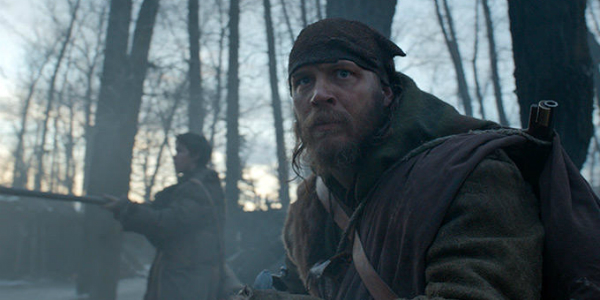
The acting in the film is consistent and well played, and one of the best elements of the entire film. Leonardo DiCaprio shines in the leading role, and whilst it can be argued that his performance isn't outstanding or vastly different from some of his other performances, he really gets into the role and his acting is strong. Not many other leading actors can portray pain and sheer misery like DiCaprio, and watching him MacGuyvering his way through the wilderness is heightened by his ability to physically portray the hardships and brutal injuries of the character, in a way that I don't think many actors would be able to pull off. Even stronger in the film however is Tom Hardy, who completely embodies the monstrous and vile character of Fitzgerald that only an actor of his calibre can do. Essentially in films like this there are two different kinds of actors; those who act the part that they are given and those who become the part and make it more than it was ever written to be. Whilst Leonardo DiCaprio plays his role incredibly well, he never truly embodies the spirit of the character in the way that Hardy can. From Bane to Ivan Locke to Max Rocketansky to the Kray twins, Hardy has the incredibly rare ability to morph into whatever part he is given, and he really has a field day in this dark and grim role. Will Poulter is also excellent, and really hasn't received enough attention or acclaim for his performance, in which he plays against the older, more experienced actors marvellously.


Technically this film is a marvel, and like Birdman before it Innaritu expertly utilises the interesting filming methods at his disposal to really draw you into the film on a visual and technical level. Shot with all natural lighting, the film looks beautiful, with the location really being emphasised at all moments and the costumes incredibly well designed. Unfortunately for the films sake the visuals and technical elements are really only a filler to the story and script, which despite the key dramatic moments early on thin out during the long second act. Pretty much all of this act is just DiCaprio having a problem with a certain injury and dealing with it, whilst dragging his maimed body towards his end goal. Whilst this is interesting and certainly shot well with a fantastic score, at moments it feels stretched out. It almost seems like there wasn't enough material for the film to be made so scenes feel drawn out, in a way that it almost becomes boring. Whilst the dream like sequences and the fantastic exchanges between Poulter, Hardy and Domnhall Gleeson break up this middle section, the action all seems episodic and you feel yourself waiting impatiently for the final act and the final pay off.

Luckily the pay off is well handled and it really brings back the sheer brutality of the early scenes as Glass tracks down the disgraced and escaped Fitzgerald. This leads to a vicious fight between the two men at the side of a river bank, which can be compared to the bear fight earlier in the film and is really well choreographed and acted, and acts as a great pay off to the long, drawn out and thoughtful odyssey for the Hugh Glass character. Tonally even in these more violent and shocking scenes and the slower more introspective scenes, the film is consistent and stylish in its delivery.

Summary: Whilst certainly not without its faults, particularly in its pacing and the script, the acting is fantastic and the film is well worth a watch for its stunning visuals alone, and is yet another example of Innaritu's mastery of innovative film making techniques

7/10

Thursday, 28 January 2016

The Hateful Eight Review

"When the handbill says "dead or alive", the rest of us just shoot you in the back from up on top a perch somewhere and bring you in dead over a saddle. But when John Ruth the Hangman catches you... You hang!"

The Hateful Eight is the aptly titled eighth feature film from visionary director Quentin Tarantino, and his second foray into the classic western genre after the immensely popular Django Unchained in 2012. The film stars an ensemble cast of Tarantino regulars; including the ever charismatic Samuel L. Jackson, Kurt Russell sporting an incredibly impressive moustache, Tim Roth in his most rodent-esque performance yet and Michael Madsen grumbling and squinting through his lines like a true cowboy. The performances from relative newcomers to the Tarantino universe are also welcoming, particularly from Channing Tatum in a small yet pivotal role.

Since conception to release the film seems to have polarised both general film audiences and critics alike, with some claiming it is one of Tarantino's best pictures and a true refinement of his film making skills, whilst others argue that it is overly long, pretentious and self-indulgent. This contrast in audience opinions and expectations could even be seen in the small Odeon screen that I watched it in, where on one side there were people gasping and laughing audibly at the action and atmosphere building on screen whilst in contrast a fair amount of people left an hour into the film, muttering about how bored they were whilst shovelling popcorn into their mouths. Personally I can understand both sides, and whilst I did love a lot of the film I can acknowledge some of the films problems over other Tarantino features. Below I will be delving heavily into spoiler territory so you have been warned.


The film opens with the gorgeous snow covered Wyoming location that establishes the films setting, then cutting to an incredibly slow and atmospheric zoom out from a Jesus statue covered in snow. This is over-cut with a roaring Morricone score and the traditional, retro opening titles, establishing quickly the typical tone of Tarantino movies; a unique yet irresistible mix of stunning cinematography, flawless direction, schlocky ultra-violence and cheeky retro cinematic tropes, like the big yellow opening titles and the old 'Ultra Panavision 70' logo emblazoned on screen, giving the film the appearance of a movie that would have been made decades before and showing yet again the directors genuine love for classic cinema and film making as a craft.


Set an undisclosed amount of time after the civil war, ex-union soldier turned Bounty Hunter Major Marquis Warren (Jackson) waits at the side of the road with a stack of three dead bodies. He is picked up by a stage coach holding fellow bounty hunter John "The Hangman" Ruth (Russell), named for his trademark preference for delivering his bounties alive to the hangman. A fun trope in Tarantino films has always been establishing these larger than life, caricatured bad-asses, like The Bear Jew from Inglourious Basterds who smashes Nazi skulls in with a baseball bat, and Stuntman Mike from Death Proof, the ex-stuntman who goes on a murderous rampage with his death proof stunt car. Here the trope is executed and presented without having to show anything to validate the notoriety, with just the context and back story behind The Hangman being entertaining in itself. Ruth is chained to his newest bounty, the murderer and gang member Daisy Domergue (Jennifer Jason Leigh), who he is transporting to the town of Red Rock to claim the bounty on. As Warren is also travelling to Red Rock to collect his bounties on the three dead bodies, Ruth hesitantly offers him a ride on his coach.

Further down the road the three pick up another traveller, the self claimed sheriff of Red Rock and racist lost-causer Chris Mannix (Walton Goggins). Tarantino's masterful direction of tension and suspense unfolds during the conversations between the characters in the coach during this section, with each having incredibly differing ideologies and opinions. This is handled fantastically, with the characters and their back stories being clearly introduced, with the racial overtones and the tensions after the civil war shown and contrasted in the characters of Warren and Mannix, which plays in great particularly later on in the film where the relationship between these two characters develops and shifts somewhat. It was at this stage that I was concerned as to whether each new character would meet each other in this episodic style, with a small chapter dedicated solely to the back story and the establishment of each new character. Already at this point the introduction of Chris had seemed somewhat happen-stance, but luckily once the stagecoach stops the drama that you'd expect from a Tarantino film picks up.

Eventually due to a blizzard the four characters are forced to stay overnight in a stagecoach lodge, Minnie's Haberdashery, to avoid the blizzard. Like the Candlyland manor in Django Unchained, the Safe-house in Reservoir Dogs, the Le Gamaar cinema in Inglourious Basterds and the Jack Rabbit Slim's 1950s diner from Pulp Fiction, this location joins the ever expanding group of iconic Tarantino locations, that not only match the genre style in a unique way but also have such a lived in and unique look and have such an affect on the story as a whole that they act almost as a character in themselves. Minnie's Haberdashery acts like a stage in a play, with small, potentially insignificant details in the décor having emphasis or a part to play as the story unfolds. The imagery of the quaint cabin against the desolate and stark winter setting makes it visually striking and unique, and puts no doubt in having the familiar aesthetic of a Tarantino movie.

In the cabin are another odd selection of characters; Sanford Smithers, an elderly ex-confederate soldier (Bruce Dern) Oswaldo Mobray, the quaint and posh Red Rock hangman (Tim Roth), Bob, a Mexican entrusted with looking after the lodge for Minnie as she visits her mother (Demian Bichir) and Joe Gage, a quiet cowboy on his way to visit his mother (Michael Madsen). Ruth is suspicious of the rest of the group and is sure that at least one of them is in cahoots with Domergue, and so goes about disarming the others and trying to get to the root of the mystery. The film then plays out like a game of Cluedo, with rising tensions between characters through dialogue and difference in interest, and not one character on screen that you can truly trust to not brutally murder the others. Through exposition and dialogue and the fantastic use of music I found my stomach wrenching as I waited for the first blood that would start the chain reaction that would lead the movie to its inevitable conclusion. One section that is a perfect example of this is the part where O.B. the driver and Mannix are outside in the blizzard putting pegging into the snow to mark the way to the barn, and each peg being picked up is matched by a rising crescendo in the musical score, and just as you prepare yourself for a brutal and bloody murder to happen it cuts back to the lodge to a simple discussion over coffee. Not many directors are able to build up this much tension with simple dialogue and in one location without an inciting incident like Tarantino, and it is fun to be taken on this roller-coaster of emotion that he slowly builds with atmosphere and a sense of dread.

Eventually this period of peace ends in a spectacularly amoral and evil speech masterfully delivered by Warren to Smithers, who had already had an alteration over the latters racism, murder of many young black soldiers and resentment of the norths victory. Warren gives the elderly man some stew and a gun, and begins telling him a story of how his missing son had gone finding Warren to claim a bounty, and Warren had stripped him naked and made him march miles. When Smithers son had begged for a blanket Warren made him perform oral sex on him, and then finally killed him. This bitter story is shown in flashback and could potentially be called the darkest and most macabre moment from any Tarantino film, and it is executed fantastically. Jacksons line delivery is darkly funny and incredibly evil, and finally leads to Smithers murder by Warren, who claimed self defence as the old man pulled the gun first. This sequence is up there with the Ezekiel 25:17 speech, and the validity of the story itself adds anther level of mystery to this already great mystery film. Tarantino is always best when showing brutal tales of revenge and this sequence does not disappoint, and shows the director hasn't lost his age when it comes to showing the truly horrific and amoral, and Jackson certainly hasn't lost his edge when it comes to delivering intense, funny, horrific soliloquies of this magnitude.

After this we are in typical Tarantino territory once more after the slow build up over the first half, with a quaint cameo from Tarantino himself as the narrator, plots of poisoned coffee and the violent death of Ruth and O.B from it. This section is portrayed incredibly gruesomely it is almost comical, with the blood spurting from their mouths looking more like a scene from It's Always Sunny in Philadelphia ("I have a touch of consumption!") than a big Hollywood movie, but it is this schlocky portrayal of violence that Tarantino loves and it is endearing, particularly as other elements make the film seem so artsy and high brow it is nice to know that the director hasn't lost touch of his own style. If the first half belonged to Ruth the second certainly belongs to Major Warren, as he tries to discover who poisoned the coffee that leads to the films dramatic conclusion and the reveal to who was working along with Daisy.

All the typical Tarantino tropes are in this film, from the way scenes flow into each other, the chapters that split up key parts of the stories, flashbacks to moments in the past and the incredibly interesting and well written characters. With so many main characters all played by such wonderful actors I was worried about how well developed they would end up being, and yes whilst it can be argued that Roth and Madsen get hardly as much development as Jacksons character they all act like cogs within the machine, and are still more interesting than a major character in many other films that would be released. The performances are all fantastic, but Samuel L. Jackson stands out in possibly his best performance since Pulp Fiction, being darkly funny and brutal in a role he was born to play. I would argue that without the incredible on screen presence that Jackson brings to the role the film wouldn't have been as powerful as it turned out being.

The films let downs probably come from its pacing, particularly in the early parts of the film. Anyone going in expecting Kill Bill levels of gore and violence from the get go will be disappointed, as the build up is far slower than Tarantino has dared do before. Unfortunately unlike the almost equally long Django it does occasionally feel its length, and certain scenes do feel like they could do with an edit. Watching the film it feels more like a directors extended edition than a typical theatrically released movie, with long takes and moments of silence that worked on occasion but still felt a little out of place. There is a scene near the beginning where Daisy's nose is broken by John Ruth, and whilst initially comical the extended shot of her face as she struggles for breath and re-cooperates herself and breathing heavily the scene becomes uncomfortable to watch.


The film was unusual in its format, being filmed on classic and rare 70mm format that makes each frame look gorgeous. I think this format would have been nicer however in a film like Django Unchained which has a variety of different locations and settings that would have benefited from this format. Here where the film is predominantly filmed on one set the format seems a little wasted. Tonally the film changes drastically after the first half, and the film goes into over the top ultra violence that fans and critics of Tarantino have come to expect. Whilst it would have been nice to see Tarantino tackle something a little quieter and different, the violence is so exhilarating, enthralling and entertaining that it's impossible to not be glued to the screen

Summary: It is nice after the epic nature of Django that Tarantino has gone back to basics to show a classic story of betrayal and mistrust that he did so masterfully in Reservoir Dogs. A few pacing and tonal issues aside, The Hateful Eight is a masterful piece of film making with a fantastic pay-off

8/10

Wednesday, 23 December 2015

Star Wars: The Force Awakens Review

"There has been an awakening. Have you felt it"
Star Wars: The Force Awakens is the seventh film in the immensely popular Star Wars saga, continuing the story after the apparent happy ending seen in the fall of the villainous and fascistic galactic empire in Return of the Jedi and beginning a brand new trilogy after a hiatus of ten years since the prequel trilogy closer Revenge of the Sith. It also marks the first film made since the acquisition of the franchise by Disney in 2012. Directing duties were handed down from series creator George Lucas to film-maker and fan JJ Abrams (Star Trek, Super 8) and it was apparent that whilst a business decision, the production of the new trilogy would come from a place of genuine love and passion for the series. Before the film even opened in theatres in amongst the hype there was an incredible mixture of hope and anxiety from fans as to whether this film could live up to the quality of the originals, or whether it would fail like the oft derided prequel trilogy. The continuation and respect of the entire series rested on The Force Awakens shoulders.

Luckily on December 17th the world more or less managed to breathe a sigh of relief as the film managed to generally live up to and exceed audience expectations, being a genuinely fun throwback to the original trilogy whilst also managing to cover enough new ground that the simple and traditional hero's journey still seemed fresh and interesting. It also succeeded marvellously in bringing in traditional Star Wars icons, imagery, locations and characters and having them blend naturally into the story without feeling forced (ignore the pun) in, like having a ridiculous plot element showing a certain Sith Lord building the prissy comic relief robot as a child (who'd ever put that into a film though right... right...). Below I will be delving into spoiler territory so be warned, as I review the highs and minimal lows of The Force Awakens.


Set around thirty years after the original trilogy, a new threat has arisen in the ever belligerent Galaxy in the form of The First Order, a vicious military unit bent on taking over political power in the Galaxy from the Resistance, the re-branded Rebel Alliance. Luke Skywalker, the last jedi and protagonist of the original trilogy, has gone into hiding after his apprentice Kylo Ren was seduced by the dark side and his attempts to rebuild the jedi order were thwarted. As The First Order rise in power, General Leia sends the Resistances best pilot, the cocky Poe Dameron, in search of a map that will help them find Luke and bring him home. This is all revealed in the films opening crawl, one of the iconic Star Wars staples complete with dramatic fan fare and text scrolling away into the horizon. Traditionally cheesy, this opening crawl was very strong and set the scene and tone well, not needing a long scene of exposition to begin the story and delving straight into the key problem; the vanishing of our hero and the rise of a new threat.

We are thrust straight into the action as Poe (played marvellously by Oscar Isaac) and his loveable droid sidekick BB-8 are meeting with an old Resistance ally on the desert planet of Jakku. However, they are soon stopped by an attack on the village by The First Order, where Poe is captured and BB-8 escapes into the desert with the map. During this battle the focus shifts smoothly in a Birdman style tracking shot between Poe and his droid making their attempt at a daring escape to an ordinary Storm Trooper within the army invading Jakku, horrified at the violence of his fellow army and later revealed to be one of the films protagonists; FN-2187, nicknamed Finn (played by relative newcomer John Boyega). With him we see the horrifying side of war from the perspective of both sides, and he is also characterised with an unusual angle unseen in other Star Wars films. The Star Wars universe is typically populated by powerful warriors, amazing pilots and diplomatic royalty, so it is refreshing to follow the struggles of such an ordinary and flawed character, and follow his struggle in doing what's right, his feeling of inferiority and his own moral dilemma in this fantastical galaxy. This makes up a lot of the drama in the film.


This opening sequence also does a terrific job at establishing a strong tone to the film. In amongst the genuine threat that we see on screen there are also elements of humour, traditional imagery like the binocular screen and storm troopers, and the antagonistic force being clearly established. One of the many things wrong with The Phantom Menace is that the weird Racist-fish monsters from the Trade Federation and their droid army that make up the movies half-hearted villains don't seem to have a clear goal, which makes the hero's struggle all the more difficult to relate to. Here the threat is simple and violent, and appears more gritty and realistic than the glossed over and eerily false world of the prequels. For the first time possibly since the ice battle of Hoth, the Star Wars series is finally showing the horrors of war, whilst also making the action exciting and engaging for viewers.

We are then introduced to Rey (Daisy Ridley), who is the more central protagonist of the film. She is a scavenger on Jakku, abandoned there by her parents during childhood and who spends her days earning meagre amounts of food from selling various scrap parts from old Empire ships. By chance she comes across and befriends the BB-8 droid. Meanwhile, Finn has a change of heart and plots a daring escape from The First Order with Poe. However, the two crash on Jakku and are separated. This leads to Rey and Finn meeting and having to escape the planet on board an old run down ship in a junk yard; the Millennium Falcon. The chemistry between all three leads is very strong, and their meeting makes sense within the films context. Like the episodic structure of the first film as the droids meet Luke, Luke meets Obi Wan, the group meet Han Solo and then rescue Leia, the characters are introduced to each other in The Force Awakens in a similar way. In other films this may not work as well, but within a Star Wars film this fits the style perfectly. The introduction and use of the Falcon makes sense within the context of the story and doesn't feel forced in, and its introduction mixed with the rising Star Wars theme is enough to bring a smile to even the hardest hearted viewer.


The films plot really begins when we are introduced to the familiar faces of Han Solo and Chewbacca, who find our heroes and explain what has happened between Return of the Jedi and now. Seeing Han Solo back to his old ways is a bit confusing after his development in the original trilogy, but it is explained and makes sense, and the sequence aboard his ship with the deadly alien monsters is fun if a little out of place. They then go to the home of Maz Kanata, an ancient space pirate who explains to Rey and Finn more of the history of the jedi and brings in another of the films MacGuffins in the form of Anakin and Luke's blue lightsaber, which now calls to Rey. This perhaps hints at Reys potential Skywalker lineage or more likely an emotional connection to the Skywalker dynasty through the force. The way the force is explained in this is more akin to the mystery and magic in the original movies, instead of a weak attempt at a scientific explanation. This brings the series yet again more to its roots, and shows more of a sense of childhood wonder that makes it both fun and engaging for the audience.

It would perhaps at this point be worth mentioning one of the more negative aspects of The Force Awakens; the CG characters. In most of the marketing for the film, the use of practical effects and real world locations were shown off and celebrated, both to appease fans who complained over the sterile, computer generated look of the prequels and to link it more to the classic nostalgia of the originals. The practical creature designs are bizarre, interesting and wonderful, particularly the odd assortment of aliens on Jakku, such as the basket carrying alien shown in early set footage.


Alternatively I would say the main CGI characters, such as Maz, Supreme Leader Snoke and the Junk-yard boss, aren't as interesting and well designed as these traditional puppets. Understandably CG was used to make the various alien characters more expressive, but this has lead to many characters, particularly Maz, to appear cartoonish and odd, and firmly on the wrong side of Uncanny Valley. In the originals one of the key alien characters was the wise mentor Yoda, who has a similar character function as Maz. For him, the character and expressions are shown with skill from the puppeteer, and it would have been nice to see this here with these few characters, as the CG characters often appeared as Roger Rabbit like cartoons inhabiting a realistic world, an element that took me out of the movie somewhat.

So after this meeting Maz's castle/cantina bar is destroyed and we see in an impressive sequence more of the traditional battle between the Resistance in their X-Wings and the First Order in Tie Fighters, with a small fight happening on the ground. This sequence has one of the more interesting uses of a lightsaber, as the non-force sensitive character Finn uses it simply as a weapon in his fight against storm troopers. Ridding the lightsaber fights of the typical choreography and separating it from the force makes the fight appear more real and increases the level of tension and drama in the scene. Rey is then taken by the First Order and their plan of using a new super-weapon; the Starkiller Base, is revealed. This raises the bar from the previous two Death Stars, with a weapon the size of a planet that can destroy five planets at once by absorbing the power of a star. Whilst treading old ground with this space station, it is used only as a back drop for the more personal drama in the film so in that way I can accept it. There is also an emotional reunion between Leia and Han, with Carrie Fisher and Harrison Ford still exuding the same chemistry on screen as they did over thirty years ago.


As the resistance plans to destroy the base, our heroes plan to rescue Rey. It is also revealed that the mysterious, deadly and psychotic villain Kylo Ren is in fact the son of Han Solo and Princess Leia, and to fully go over to the dark side Kylo is instructed that he must kill his father. As all the characters storylines converge on Starkiller base, Rey discovers her own control over the force, and Han has an emotional confrontation with his estranged son, that leads to Kylo murdering fan favourite Solo, doing what Vader could never do by cutting off family ties to fully turn over to the dark side. This is perhaps the most emotional and heart felt scene in the entire saga, and is handled wonderfully with the use of the location of a mechanical bridge over a never ending chasm reflecting the characters inner turmoil, the use of sound and music, and the diminishing light from the dying sun reflecting the darkness of the situation. From these elements, the iconic character of Han Solo goes out in an incredibly emotional and poignant way, in fitting for the scruffy looking nerf herder. Chewbacca's violent and emotional reaction to his best friends death by shooting at Kylo and exploding the base is also incredibly moving.

This leads into the strongest sequence of the entire film in my opinion; the confrontation between the two protagonists and our antagonist in a snowy woodland as the base begins collapsing around them. As Rey is injured the non jedi Finn coaxes the bloodied and psychotic Kylo into a lightsaber duel. He briefly holds his own before being brutally injured in a scene that finally provides a fitting explanation for the exhaust hilt on Kylo's saber. As Kylo Ren attempts to draw the Skywalker lightsaber using the force, what he views as his birth right, it is instead drawn towards Rey who continues the duel. Tapping into the force Rey manages to overpower the injured Kylo as the planet separates and they are both taken away. This sequence is perhaps one of my favourite lightsaber duels ever. Gone is the irritating flawless choreography of the prequels, as we instead get a raw and visceral use of lightsabers, without the need for over powered characters and flat, dull climaxes. What was missing from many of the duels in the prequel trilogy was an emotional undercurrent to the battle, and whilst the fights may have been impressive, the overload of visuals and choreography was often cartoonish and silly, even in highly emotional duels like the final one between Anakin and Obi Wan. What makes these duels isn't necessarily the impressive swordsmanship, but is instead the inner turmoil of the characters, which The Force Awakens delivers on in amazing spectacle. Here the duel isn't overly long and remains in one setting, with the weakened and untrained participants levelling the battle field and providing some wonderful, gut wrenching tension.


After this Finn is treated at the Resistance base and R2, shown earlier to be in low power mode since Luke's disappearance, turns back on showing the rest of the map to Luke. Rey takes the Millennium Falcon and travels to his location; filmed on the gorgeous and remote Irish island of Skellig. This is a unique location and really adds more to the mystery and mystique of the films final act. As Rey climbs to the top she meets Luke, now aged and bearded. In the final shot she presents his old lightsaber to him. Without saying anything Mark Hamill portrays the characters history and actions from the last time we saw him on Endor; his guilt, his turmoil, his strife, and I can't wait to see more of him and the Skellig location in Episode VIII. One complaint for this final scene might come from the unusual panning helicopter shots, which seem more fitting in a 'Visit Ireland' advert than the climax to a Star Wars film.


Overall I believe the film worked on many levels, both as a film and as a cinema going experience. Before the film I knew very little about the characters, and some of the plot developments surprised me. From the marketing it appeared that Finn would be the next jedi, so I was pleasantly shocked to discover that it was in fact Rey who would be the next generations Jedi master. Just on grounds of representation in cinema both of gender and race this film exceeds expectation, and it is nice to see not another generic hero leading this new trilogy. Rey slowly discovering her powers and using the survival skills she had learnt throughout her life seemed to develop so naturally, and I'm glad that her backstory wasn't fully given to us throughout the film as there is plenty of room for speculation before episode VIII. Daisy Ridley does a terrific job in the portrayal of the character, as does John Boyega in his portrayal of Finn.

The new supporting characters and sidekicks are also nice additions and are memorable. Poe Dameron fills the suave bad-ass role previously held by Han Solo, with sharp quips and just generally being a fun and incredibly likeable character. BB-8 is an ingenious addition to the series, and does an amazing job expressing happiness and sadness in unique movements and fun quirks, like R2 but not just a cheap imitation. The returning cast are all wonderful, and the iconic characters seemed to have developed and aged enough whilst still retaining what made them popular in the first place, and all development is still in fitting with the characters personalities.

For the antagonistic side I personally think that some of the elements could have been stronger. Whilst I understand General Hux's loud, posh attitude is a throwback to General Moff Tarkin, I thought his character was a little over played and pretty unnecessary to the story. Snoke is an unusual character in both proportion and motive, and at this point it still feels like he is not filling the same shoes as the deliciously evil Emperor, but I'm sure he will be developed more further into the trilogy. Captain Phasma is by far the weakest character, mainly as from the marketing and merchandising for the film she appeared to be a major player in the films plot, and was built up as a potential new Boba Fett. However, she suffers from a complete lack of screen time. When Gwendoline Christie (Brienne of Tarth from Game of Thrones) was cast I was looking forward for her involvement in pivotal fight scenes, particularly after her battle with The Hound in the season 4 finale of the show. However she seems to have been wasted in the film, and is disposed of (quite literally) before the final act. I sincerely hope she comes back in the sequel, and hopefully with a lot more to do.


The same cannot be said for Kylo Ren, possibly the most welcome addition to the Star Wars story. Born Ben Solo, son of Han Solo and Leia Organa, and taught in the ways of the force by Luke Skywalker, Ben was seduced by the powers of the dark side by Snoke. Mirroring the actions of his maternal grandfather years before, Ben gave up his name and massacred the new Jedi order. Unusually under Kylo's unique and threatening mask he is an ordinary and plain looking young man (Adam Driver), making his characterisation as the archetypal seduced evil character even more unique in the film. At heart he is still an untrained boy, shown through his temper tantrums and unhinged attitude. With the current societal climate of young white men shooting up schools and churches, his character seems completely relevant and worryingly realistic. His seduction by the dark side establishes yet another Vader style character arc, and sets him up to be one of the most interesting characters in the film. Potentially more unstable than any villain in the series so far, Kylo is incredibly interesting and I can't wait to see him develop more throughout the rest of the trilogy, and to see him have his inevitable confrontation with his old teacher.

The films visuals are absolutely stunning, using key locations from the earlier instalments but providing a unique spin on them to make them appear brand new, and having many new and interesting locations such as Skellig that was mentioned earlier. Every single frame seems authentic and unique, and forever gone is the sterile and clean look of the prequels. This world seems old, imperfect and lived in, which is just what Star Wars should look like. The film seems to be inspired in parts by old myth and the tale of King Arthur, with castles, black knights, old robes, ancient wizards and the sword in the stone aspect with the final battle with the lightsaber going to the more worthy, and this theme is nicely carried over during the entire film. The blend of traditional science fiction futuristic elements and the traditional medieval story of a hero's journey blend seamlessly, just like how they did in the original trilogy. The use of the John Williams's score is perfect as usual and ties the film together in a neat package.

Whilst certain story elements mimic beats from The New Hope, the film still manages to find its own feet and remain engaging and interesting throughout. I have never been to the cinema and managed to stay on the edge of my seat for the entire feature like I did with this film. Overall picking apart elements of a Star Wars film is like picking apart individual lyrics from a song, with one bum line not being able to ruin the music. More than a film, The Force Awakens is an experience unlike many I have had in a cinema, with the impressive use of IMAX and 3D never getting in the way of strong storytelling, character development and genuine soul, and this film has an awful lot of it. The love that went into this is exhilarating, refreshing and addictive, and its just so nice to finally be excited about Star Wars again.

Summary: Acting both as an exhilarating spectacle of cinema and a simple character study, Abrams has managed to create possibly the second best Star Wars film and an amazing film in its own right. Roll on Episode VIII!

9/10